Clues to Xian Surname Settlements and a Cross-Regional Genealogical Research Path
Existing materials indicate that people bearing the Xian surname are distributed across Shandong, Henan, Jiangsu, Northeast China, and parts of Southwest and Northwest China, with scattered records also found overseas. Place-name clues are particularly concentrated in Shandong, but whether Xian families in different regions share the same ancestry and how their migrations are related still require branch-by-branch verification against family genealogies, local gazetteers, inscriptions, and household-registration records.
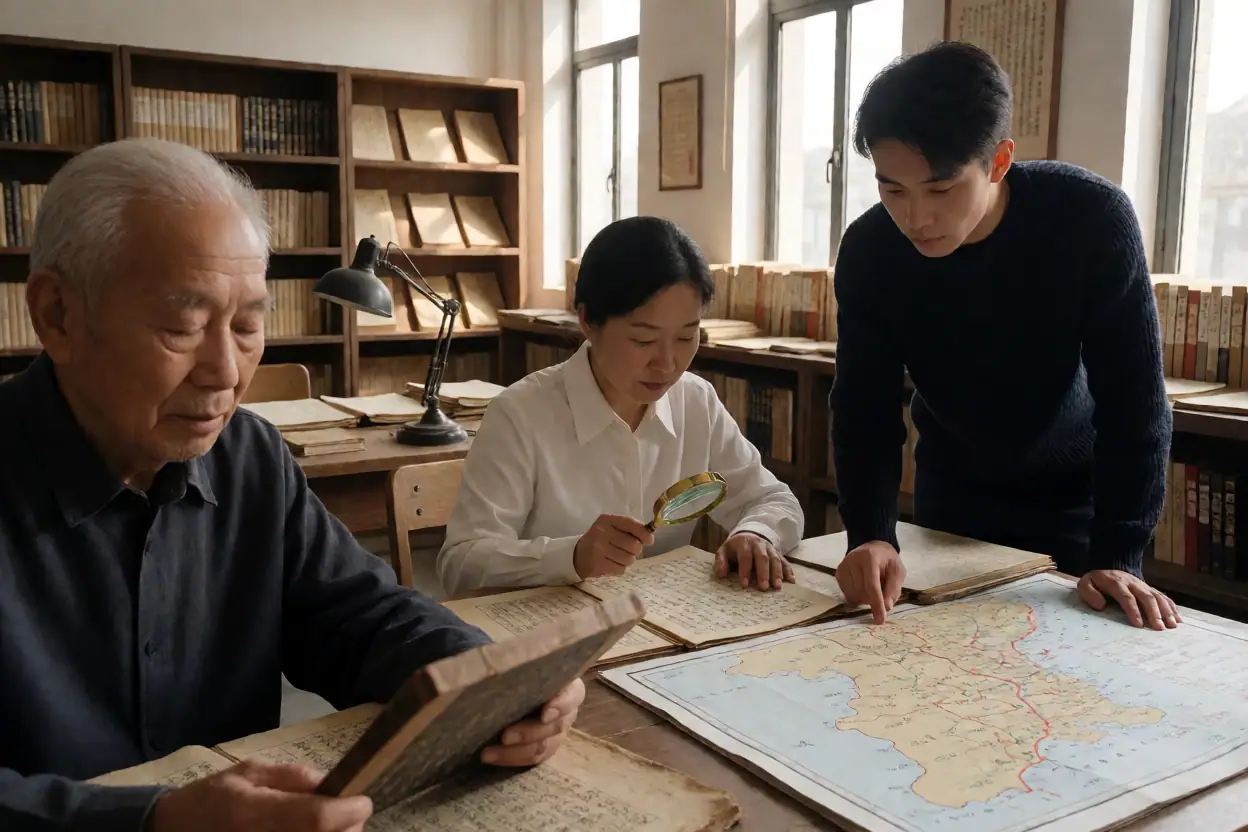
The Xian surname is relatively uncommon among surnames in China. Existing distribution records show a pattern of scattered settlement, with some villages having relatively concentrated populations. Based on currently available geographic information, Shandong contains a comparatively large number of relevant locations, including Laixi, Qingdao; Jingzhi, Anqiu; Changcheng, Zhucheng; Pingyuan and Huimin in Dezhou; Yantai; Dong'e; Junan; Pingyi; Mengyin; Tai'an; Zaozhuang; and Tengzhou. Some place names, such as “Xianjiazhuang,” “Xianjiatun,” and “Xianji,” display characteristics of surname-based settlements and may serve as starting points for investigating a family's residential history. However, identical place names or place names containing a surname character cannot directly prove that all local residents belong to the same lineage.
Outside Shandong, records of Xian surname distribution have also been found in Taikang and Xinxiang in Henan; Donghai, Dafeng in Yancheng, and Suining in Xuzhou in Jiangsu; Daxing'anling, Yichun, and Gannan in Heilongjiang; and Siping, Baishan, and Nong'an in Changchun, Jilin. Relevant clues have also been found in Pingnan, Guangxi; Jingyuan and Longde, Ningxia; Bozhou, Anhui; Suizhong and Shenyang, Liaoning; Cangzhou, Hebei; and Chongqing. Information on people with the Xian surname has also appeared in urban Beijing and overseas locations such as Moscow, Russia, and Japan. However, the dates when these records were created, the population sizes, and the places of departure remain unclear, so they cannot be used to outline a definite migration route.
In terms of geographic concentration, Shandong may be one of the important areas for studying Xian surname settlements and migration. If a family branch preserves an oral tradition that it “migrated from Shandong,” priority should be given to verifying the name of the original county, the former village name, the name of the founding migrant ancestor, the spouse's surname, generational characters, and the location of ancestral graves. Particular attention should be paid to confusion caused by changes in administrative divisions, variant forms of village names, and villages with the same name. For Xian surname branches in Liaoning, Jilin, Heilongjiang, and other regions, cross-checking can also draw on migration movements since the Qing dynasty, household registration records from the Republic of China period, and records of people, villages, and settlements in local gazetteers. However, until the chain of evidence is complete, it is not advisable to broadly classify them as a single migration branch.

For genealogical research, families can first organize materials held within the household, arranging old genealogies, ancestral spirit tablets, ink rubbings of tomb inscriptions, contracts, letters, photo inscriptions, and oral accounts from elders in chronological order. Online genealogies are suitable for recording confirmed family relationships and identifying the provider and basis for each piece of information. For lineages that remain disputed, the “Pending verification” status should be retained to avoid forcing connections based solely on people with the same name. Family memoirs can supplement the record with reasons for relocation, occupational changes, marital connections, and village life, preserving family experiences beyond the genealogy itself.
Local gazetteer databases can be used to search for historical administrative changes, village establishments, surname settlements, school directories, and biographies, and to compare these findings with genealogical records. Hall names, commandery origins, generational characters, and founding ancestor information can help identify lineage branches, but none of them can independently serve as proof of blood relationship. Sharing a surname does not necessarily mean sharing the same lineage, and Xian families in different regions may have developed under different circumstances. A more reliable approach is to trace upward generation by generation from recent ancestors who can be confirmed, establishing the lineage through materials in which dates, locations, and family relationships corroborate one another before discussing more remote origins and migration.