Figures and Migration Memories of the Gong Clan: From Literati Painters to Local Worthies
Figures surnamed Gong appear in fields such as literature, painting, the imperial examinations, and local governance. Based on existing materials, the experiences of Gong Xian, Gong Jian, and Gong Yi offer a view of the diverse facets of Gong clan cultural memory, but specific lineage branches still need to be verified item by item through genealogies, local gazetteers, and family documents.
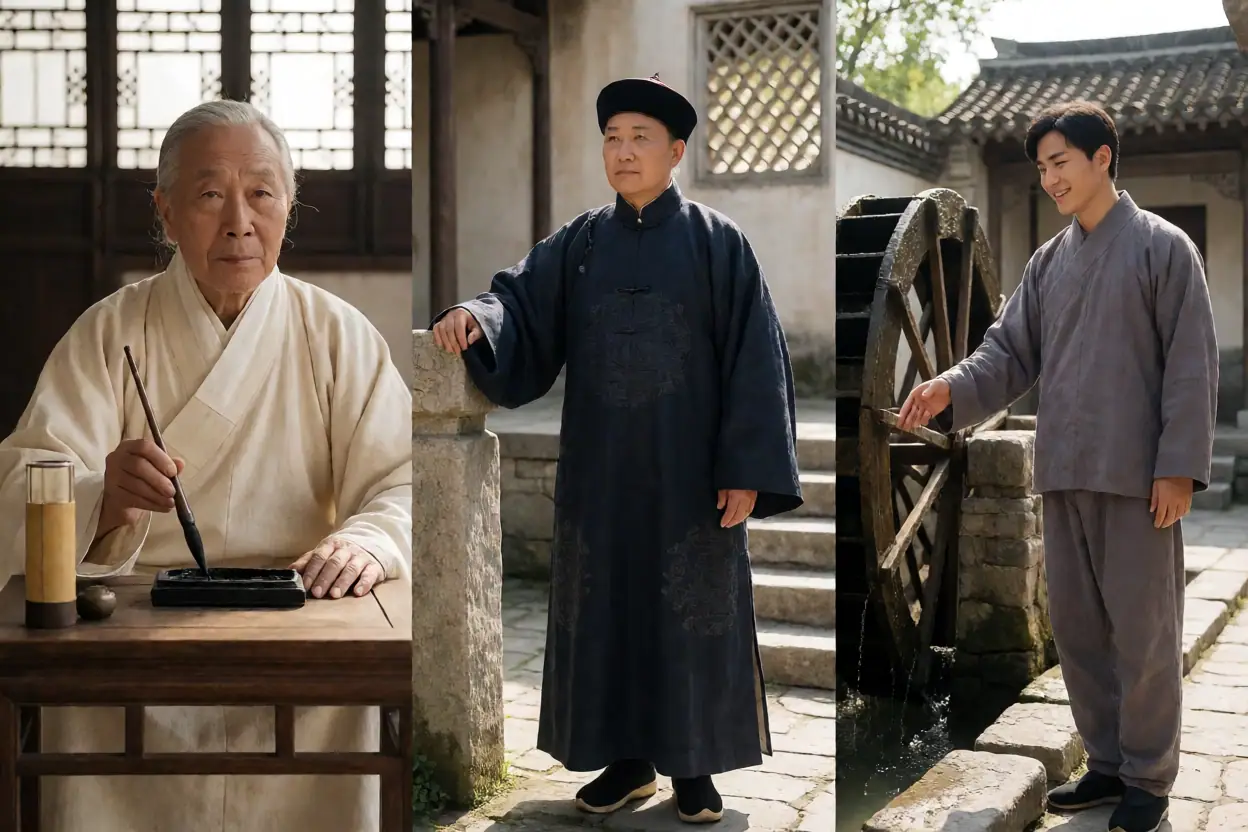
Historical figures surnamed Gong were active across a broad range of regions, and their identities were not limited to any single field. Existing surname materials list Wuling, Liugui, Bohai, and others as commandery associations or hall names related to the Gong clan, and also mention distributions in Hunan, Sichuan, Jiangxi, Guangdong, Hubei, and other places. However, commandery associations, hall names, and regional distribution can only serve as research clues; they cannot be used to directly determine that Gong residents in different regions belong to the same lineage branch. Regarding the early origins of the Gong clan, sources contain different accounts, such as links to the Gong clan and descendants of Gonggong, which still require analysis in conjunction with specific genealogies and historical documents.
Gong Xian, given name Banqian and art name Yeyi, was an influential painter in the Nanjing area in the early Qing dynasty, and art histories usually include him among the “Eight Masters of Jinling.” Relevant records state that he was highly renowned for his poetry in his early years, but later, because of his outstanding achievements in painting, his literary contributions received comparatively less attention. Gong Xian lived for a long time around Qingliang Mountain in Nanjing and had extensive interactions with Ming loyalists and early Qing literati. While Kong Shangren was writing The Peach Blossom Fan, he collected accounts of late Ming events in Nanjing, Yangzhou, and other places. Gong Xian’s experiences, social contacts, and identity as a Ming loyalist may have provided important historical context and oral materials for the work. The specific circumstances of their interactions, as well as Gong Xian’s role in the formation of the drama, should be examined by cross-referencing collected writings, art histories, local gazetteers, and related research, and should not be over-inferred from summaries alone.
The deeds of Gong Jian present another aspect of imperial examination figures participating in local water-conservancy construction. According to records, he was the sixth-generation ancestor of the Gong clan in the Lechang area. In the first year of Kaiqing in the Southern Song dynasty, he and his younger brother Gong Yuan both passed the jinshi examination. Later, because of political turmoil, he lived in seclusion in his hometown. Afterward, he organized villagers to build weirs and irrigation channels, diverting water to irrigate dry fields and forming what locals called the “Double Weirs” and “Double Weir Channel,” leaving behind the local memory of the “Jinshi Weir.” Such stories include both personal traces and the collective memory of rural society regarding water conservancy, public welfare, and local worthies. To confirm his lineage, changes in residence, and the evolution of water-conservancy remains, one should also consult Lechang local gazetteers, stele inscriptions, and relevant Gong clan genealogies.
Gong Yi’s experience was connected with the Ming-Qing transition. Sources state that his courtesy name was Hemei, that his ancestral home was in Shandong, and that his forebears moved to Shunning, Yunnan, in the early Ming dynasty. He later passed the provincial examination and became a jinshi, and once held an official post in the Ministry of War in Nanjing. After the establishment of the Southern Ming Yongli regime, he took part in military and administrative affairs, serving as Vice Minister of War and Minister of Revenue, and moved with the regime to Yunnan, where he undertook tasks such as recruiting soldiers and raising grain supplies. Regarding his ancestral home, the timing of the move to Yunnan, his official career, and the distribution of his descendants, local archives and genealogical accounts may differ in level of detail, and should be corroborated through official histories, local gazetteers, stele biographies, and genealogies.
These figures show that Gong historical memory includes not only literary and artistic achievements, but also imperial examination honors, local public welfare, and migration experiences. Online genealogies can be used to organize clues about branches, generation names, and places of residence; family memoirs help preserve modern and contemporary accounts of migration and kinship; and local gazetteer databases can supplement the geographical and institutional background of figures’ activities. In ancestral research, one should first confirm information such as the first migrating ancestor, place of residence, ancestral tombs, or ancestral halls, and then verify people with the same name, similar hall names, and similar legends separately, in order to avoid mistaking a shared surname for a shared lineage.
Learn More and Verify
- A careful compilation of clues from the Qing clan genealogical records and migration memories
- An examination of the Chushi settlements, ancestral halls, and migration memories in eastern Shandong
- The Lin clan’s Huaide Hall in Nanpi, Zhao’an: the migration memories of an ancestral hall
- Research into Xing clan figures and family history through records of Xing Nanrong
Genealogy Knowledge and Methods for Compiling Genealogies · Finding Genealogies and Local Gazetteers · Organize family-root-seeking leads