Population Distribution of the Wei (尉) Surname and an Analysis of Ancestral-Search Clues
Existing sources indicate that the Wei (尉) surname has a relatively small population, with distribution reported in Shanxi as well as North China, Northwest China, East China, and other areas. People bearing the Wei surname in different regions may not share the same ancestral line. The specific origins, migrations, and genealogical lines still need to be verified item by item against family genealogies, local gazetteers, and family memories.
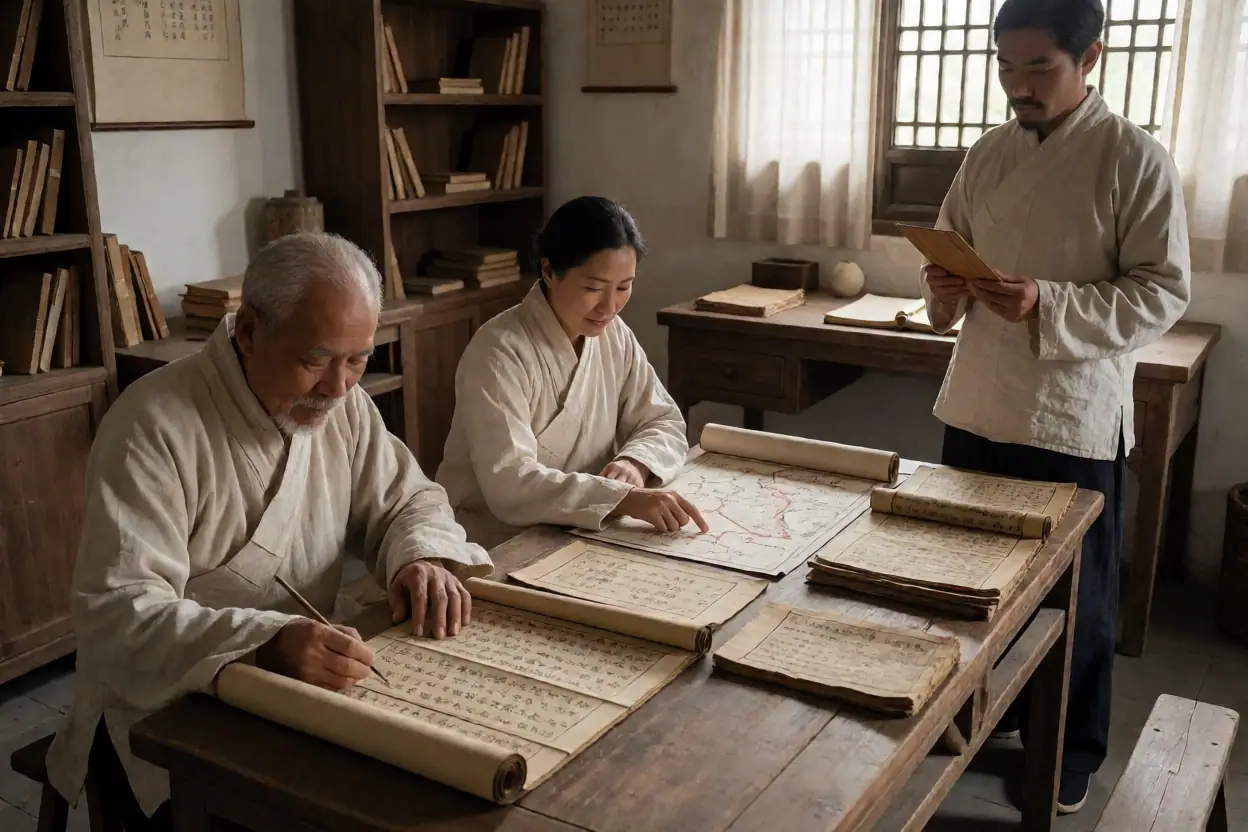
The Wei (尉) surname is one of the less common Chinese surnames written with a Chinese character. Existing sources classify it among surnames with relatively small contemporary populations and identify Shanxi as a region where the surname is comparatively concentrated. Clues indicating Wei-surname residents have also been found in Hebei, Shandong, Henan, Shaanxi, Gansu, Inner Mongolia, Liaoning, Anhui, Hubei, Sichuan, Guangdong, and other areas. Because the statistical criteria, sample coverage, and place-name records involved are not entirely consistent, this information is better treated as a starting point for ancestral research rather than as a complete and precise population ranking or map of nationwide distribution.
The place names listed so far suggest that the Wei surname is distributed across multiple regions. In Shanxi, clues point to places including Taiyuan, Shuozhou, Fenyang, Pingyao, and Wenshui. In Shandong, they include Laiyang, Laixi, Jinan, Yucheng, Dongping, Jining, Tai'an, Yantai, and Rizhao. Relevant records also appear in Henan, Hebei, Shaanxi, Gansu, and parts of Inner Mongolia. Residents bearing the Wei surname have likewise been reported in several cities in East China, South China, Southwest China, and Northeast China. The appearance of a place name can only indicate that the surname was used or that a family was active there during a particular period; it cannot establish that clans in different places necessarily share a common ancestor.
The specific origin of the Wei surname, its early founding ancestors, and its principal migration routes should still be determined from documents that can be linked to specific branches. When researching a particular branch, begin by recording what elders in the family recall about the place of origin, places of migration, generation names, burial sites, ancestral halls, and marital connections, then cross-check these details against surviving clan genealogies, family genealogy manuscripts, inscriptions, and local gazetteers. Particular attention should be paid to the pronunciation, variant written forms, and transcription differences of the character 尉, to avoid conflating different surnames because of identical sounds, similar forms, or data-entry errors.
The Wei (尉) surname should not be equated simply with the Yuchi (尉迟) surname. Yuchi Jingde was a renowned general of the Tang dynasty and was later also venerated as one of the traditional door gods. However, historical records concerning the Yuchi clan cannot automatically prove that an ordinary Wei-surname family has a genealogical connection with it. Ancestral relationships should be assessed by seeking continuous genealogical records, clearly identified migration points, and regional materials that corroborate one another, rather than drawing conclusions solely from legends about famous figures, ancestral hall names, or shared surnames.
In actual ancestral research, surname databases can help organize distribution across different regions and documentary clues, while online family genealogies are useful for comparing branches, generation names, and migration information. Family memoirs can preserve oral histories, old photographs, and memories of ancestral homes. To confirm the origins of a particular Wei-surname branch, researchers should also consult county gazetteers, local gazetteers, ancestral-hall inscriptions, and epitaphs, and verify different versions item by item. Only through cross-checking these materials can a comparatively reliable family lineage gradually be established, avoiding the mistake of treating regional distribution as proof of a shared clan origin.