Researching the “个” Surname: From Character-Form Clues to the Analysis of Family Genealogies
Existing materials list “个” as a surname entry requiring further verification, and no clear conclusions have yet been established regarding its commandery affiliation, ancestral hall name, ancestors, or geographic associations. Focusing on character forms, genealogical records, migration, and local literature, this article outlines approaches that may be used to research the “个” surname and the boundaries of interpretation that should be maintained.
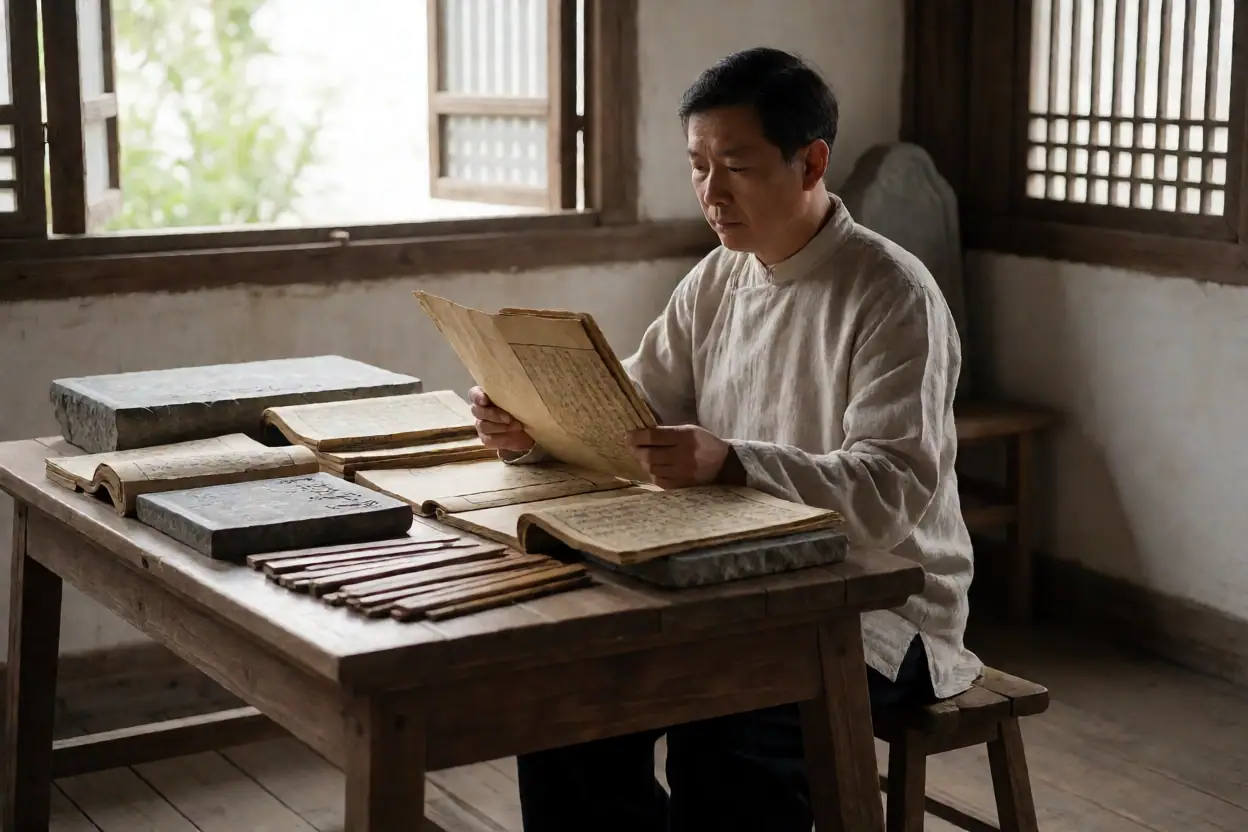
When “个” appears as a surname entry, the first task is not to trace a famous person or founding ancestor directly, but to confirm the character form, pronunciation, and nature of the record. In the information compiled to date, the pinyin has not yet been determined, the ancestral hall name is listed as requiring further research, and no clear conclusions have been established regarding its county affiliation or related geographic associations. Accordingly, it is more appropriate at present to regard it as a subject requiring continued verification, rather than to infer its origin, commandery affiliation, or branch lineage from it.
In surname research, a single character form may correspond to a variety of circumstances. It may be a surname used by a family over many generations, or it may be connected with variant characters, simplified characters, transcription differences, dialect pronunciations, or the conversion of written forms during registration. To determine whether “个” is a consistently inherited surname, priority should be given to comparing the forms found in original genealogies, tombstones, contracts, household registers, and local documents, while examining whether these materials corroborate one another across different periods and among different family members. Online entries, a single genealogy, or modern registration information alone are generally insufficient to establish a complete lineage.
Genealogies are an important source for further research, but identical genealogy titles and nearby places of residence do not necessarily indicate common ancestry. When organizing online genealogies, information such as the place of genealogical origin, date of compilation, founding ancestor of the migration, generation names, and ancestral shrine or ancestral hall name should be recorded separately. The records of people, marriages, relocations, and burials in different genealogies should then be compared item by item. Statuses such as “ancestral hall pending verification” and “pending verification” should retain their original uncertainty and must not be interpreted as a particular confirmed ancestral hall name or county affiliation. Family memoirs are also valuable, especially for supplementing information about relocations, name changes, branch divisions, and spoken forms of address in modern times, but oral materials still need to be corroborated by written documents.

A “family migration route” may serve as a direction for research, but it is not a confirmed ancestor and cannot directly prove that all families with the “个” surname came from the same lineage. In tracing family origins, researchers may begin with the earliest extant generation and organize information on places of birth, places of residence, marital relationships, burial sites, and the distribution of descendants, gradually forming a timeline. They can then consult local gazetteer databases to look for information on the development of relevant villages, surname distribution, ancestral shrine records, and migration caused by disasters or unrest. Records of people with the same surname in local gazetteers can only show that related individuals or families were active in a particular place; whether they were connected to a specific family still depends on whether the names, generational sequence, dates, and kinship relationships correspond.
Subsequent research could establish a verifiable data table: one column to record the wording of the original text, one to record the source and date, one to identify conjectural content, and another to specify matters that have been corroborated or remain to be verified. This would both facilitate the addition of new genealogy images and help prevent legends, similar surnames, or accidental cases of identical names from being mistakenly linked to a direct ancestor. Based on the information currently available, the ancestral hall name, geographic distribution, founding ancestor of the migration, and complete lineage of the “个” surname should all remain open questions; any specific conclusion requires support from more original materials.
Learn More and Verify
- Compiling the Xue Surname’s Generation Names in Fujian: From Regional Clues to Analysis of Family Genealogies
- Clues to the Diao surname’s generation names and compilation of family genealogies in multiple parts of Beijing
- Volume 6 of the Baimaotang Chen Clan Genealogy: from the genealogy title to family clues
- Genealogical Materials and Branch-Line Analysis of the Chu Surname in Shandong
Genealogy Knowledge and Methods for Compiling Genealogies · Finding Genealogies and Local Gazetteers · Organize family-root-seeking leads