Clues from Jiangxi, Fujian, and Guangdong and Paths for Verifying the Xing Surname’s Migration History
Existing records on the Xing surname present a migration framework extending from narratives of northern origins to Jiangxi, and then onward to Fujian, Guangdong, and other regions. Relevant founding ancestors, generational sequences, dates, and routes are often found in clan memory and still need to be checked item by item against original genealogies, local gazetteers, inscriptions, and household registration documents.
Although the Xing population is relatively small, its migration narratives span multiple historical periods and regions. Existing materials broadly form a trail from legends of northern origins to settlement in Jiangxi, followed by expansion from Jiangxi to Fujian, Guangdong, Sichuan, Hubei, Taiwan, and overseas. It should be noted that this overall framework derives primarily from clan documents and later compilations and cannot be directly regarded as a shared, continuous genealogy of all Xing families.
Regarding the origin of the surname, one theory associates Xing with the ancient designation “favored minister,” while another clan narrative states that the founding ancestor, Xing Yan, was granted the surname for meritorious service and places his early activities in areas such as Qingchi and Yanmen. These accounts involve Western Zhou dating, the system of bestowing surnames, and the identities of historical figures; given their antiquity, the evidentiary chain still needs to be strengthened. Research should examine early genealogical prefaces, historical surname books, changes in place names, and extant epigraphic materials, distinguishing between family legends, genealogical retrospection, and historical records that can corroborate one another.
Jiangxi is a particularly prominent region in records concerning Xing migration. Relevant accounts mention that different branches once lived in or moved through Gao’an, Fengxin, Xiushui, Ruichang, Guangchang, Suichuan, Shangyou, Nankang, and Yudu. Gao’an is often regarded as an important node for several Xing branches in Jiangnan, while Fengxin, Xiushui, and other places are associated with accounts of branches relocating from Gao’an. Some genealogies also identify Xing Maohong, Kuogong, and their descendants as key figures linking earlier and later generations. However, genealogical editions from different places may differ in generational sequences, kinship relationships, and dates of relocation; shared names or similar generation characters alone cannot establish membership in the same lineage.
The route from southern Jiangxi to Fujian and Guangdong also merits attention. Some materials state that one branch of Xing Dengyi was active around Suichuan, Shangyou, and Nankang, after which his descendants moved to Shibi in Ninghua, Fujian, and then, in the early Ming period, continued into Xingning and the areas around Meizhou in Guangdong before dispersing to other parts of Guangdong. This route resembles the migration patterns found in the oral histories of many Hakka clans, but similarity of route does not imply shared ancestry. Places such as Shibi in Ninghua may also have served in later genealogies as cultural landmarks summarizing ancestral homes or stages of migration. For any particular family, it remains necessary to seek records of names in local genealogies, ancestral-hall inscriptions, contracts, and local gazetteers.

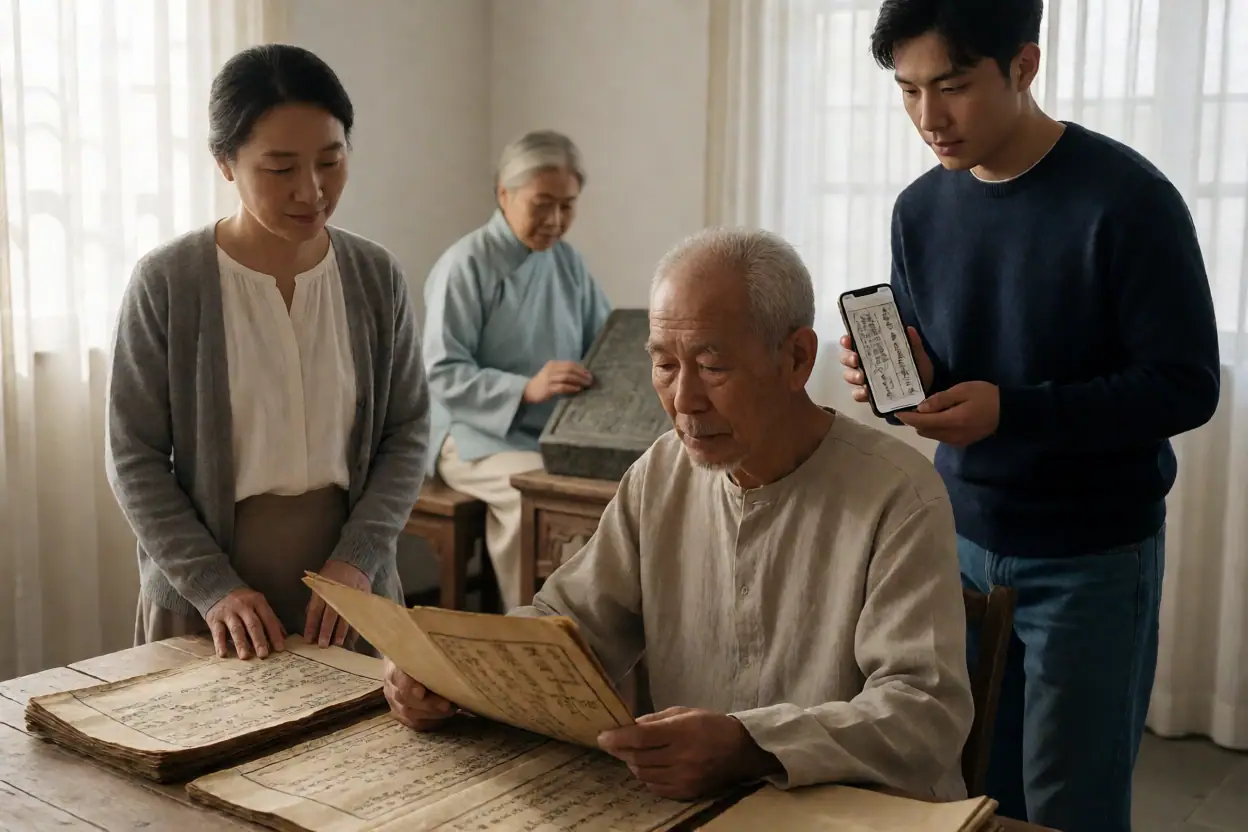
When tracing one’s roots, begin with known recent ancestors by recording their names, generation characters, spouses, places of residence, birth periods, and burial locations, then verify the line one generation at a time. Online genealogies are useful for organizing lineage relationships and comparing variant readings; family memoirs can preserve memories of relocations, marriages, occupations, and rituals; and surname databases and local-gazetteer repositories can help verify former place names, administrative changes, and biographical records. Oral information should identify the speaker and the date it was recorded, while visual materials should retain inscriptions, page numbers, and edition information.
Existing archives also contain records on the Sima surname, describing it as a compound surname derived from an official title and including information about Henei Hall and regions such as Henan and Shanxi. The Sima surname records have no direct genealogical connection with the migration narratives of the Xing surname and should not be conflated merely because the materials appear together. Whether a shared branch can ultimately be confirmed should be determined through the combined corroboration of genealogical links, generation-character correspondence, kinship relationships, and multiple local documents.