
Explain why the genealogy is being compiled and what rules it follows
Genealogy title, preface, editorial guidelines, table of contents, compilation notes, ancestral portraits and eulogies, generation-name chart, and family symbols.
ZongMai Genealogy Knowledge Guide
From organizing family relationships for the first time to verifying lineages, continuing old genealogies, arranging genealogy books, and preserving them long term, this guide answers the most common questions in the genealogy revision process with clear, actionable methods.
Find answers by genealogy-building stage. Each question provides practical handling principles. If there are still differences of opinion within the family, they should first be written into the general notes and jointly confirmed.
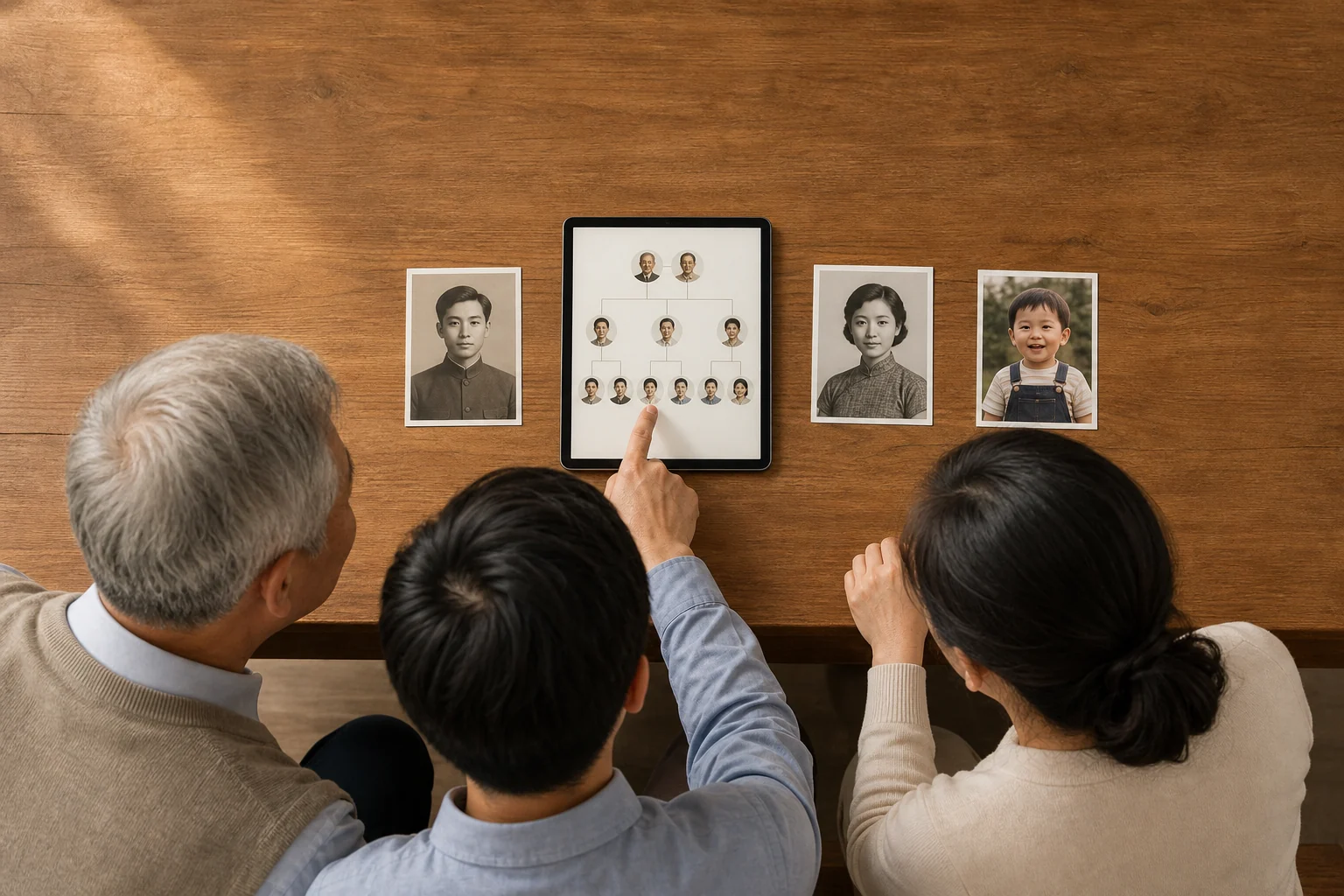
Build a reliable foundation first, without rushing to trace back to the earliest ancestor.
Yes. Start withpeople who can be confirmed within three to five generationssuch as yourself, your parents, and your grandparents, then gradually add siblings, spouses, and children. Earlier lineages can continue to be researched through interviews with elders, household registration materials, tombstones, old photos, ancestral hall records, and materials from relatives of the same branch.
Do not guess at information that cannot be confirmed. Mark it as “to be verified” or “according to an elder’s oral account,” and revise it later when evidence is found.
Online genealogy building usually starts with the current logged-in user, adding parents and ancestors upward, siblings and spouses to the sides, and children downward. For a formal genealogy book, first determine thefirst migrating ancestor, founding ancestor, or common ancestor, then expand each family branch by generation.
Yes. One person may appear at the same time in a paternal genealogy, maternal genealogy, spouse’s genealogy, or within the collaboration scope of different branches. The system should link multiple genealogies to the same person identity to avoid data conflicts caused by duplicate entries; however, each genealogy may have different display scopes and inclusion rules.
A modern genealogy focuses on accurately recording family relationships while respecting the individual’s wishes.
Yes. Modern genealogies should generally record women and spouses in full. It is recommended to record at least basic information such as name, relationship to the person in this branch, and year of birth. Whether children continue to be expanded and whether a spouse’s parents are included should be defined uniformly in the general rules of the entire genealogy to avoid inconsistent standards within the same genealogy.
A distinction should be made amongbiological relationships, legal relationships, and actual caregiving relationships, rather than replacing them with a single vague father-son line. In a formal genealogy book, a person’s entry may note “given in succession,” “continued the ancestral line,” “adopted,” or “stepchild,” while preserving the sources. When living members are involved, their consent should be obtained first.
Record marital relationships based on facts and chronological order, without using judgmental wording. Whether to disclose the time of divorce, remarriage details, and information about minor children should be authorized by the individual or guardian. A public version may retain only the necessary relationships, while the internal family version may display the complete information.
Information on deceased members may be recorded with family authorization, including birth and death dates, burial place, deeds, and images. Privacy should be protected more strictly for living members: full birthdays, phone numbers, addresses, IDs, health, income, and private experiences should not be public by default, and only the necessary information required to complete the genealogy should be retained.
One person may have multiple names, but the meaning of each field must remain fixed.
Genealogy nameis the name used consistently in the genealogy;current nameis the name currently used officially; a former name is a name once used officially; a childhood name or nickname is a family form of address. The four should not be mixed in the same name field. A person card should preferably display the genealogy name or current name, while other names should be placed in the details.
Generation characters should be recorded separately, with the branch and source of the generation-character table indicated. Not using a generation character in the name does not mean there is no generational order; the generation can still be determined according to a reliable lineage. When generation characters differ among branches, they should not be forcibly merged, but should be stored separately with an explanation of how they connect.
Fill in the date according to the known level of precision: if only the year is known, enter only the year and do not fabricate the month or day; if only the lunar date is known, it should be clearly marked as lunar. When a date comes from oral accounts or estimation, it should be noted as “circa,” “according to oral account,” or “to be verified.”
This must be clearly explained in the general rules. A common practice is to record the order among children of the same parents; some genealogies also record the order among peers within the same house branch. System fields should distinguish “family birth order” from “house-branch order,” and the formal person card should display only the one uniformly adopted in this genealogy.
Being able to explain the basis is more important than having fields appear complete.
At minimum, verify parents or spouse, era of birth, place of residence, house branch, siblings, and sources at the same time. The same name alone cannot establish that they are the same person. Internally, the system should assign an independent ID to each person, with the name used only as a display field.
Do not delete one version directly. Record the source, time of creation, original text, and credibility of each version separately, then let the genealogy compilation members discuss them. Contemporary original records usually take precedence over later retellings, but copying errors in old genealogies should also be considered. If there is no conclusion yet, retain an explanation of differing accounts in the genealogy.
A connectable common ancestor should be found, and the generation order, migration places, generation characters, hall name, prefaces and postscripts of old genealogies, and chronology should be checked for compatibility. Having only the same surname, the same hall name, or similar legends is not enough to prove common ancestry. When an evidence chain cannot be established, it is better to first create “related branch materials” rather than directly merging the lineages.
Internal compilation archives should preserve sources for future review; public-facing pages do not need to display identification documents, contact information, or internal research notes. A formal genealogy book may list old genealogy editions, local gazetteers, and inscription sources suitable for public disclosure in the general rules, references, or notes.
Turn the old genealogy into verifiable data first, then discuss layout and print quantity.
It is not just about appending names. Before continuing a genealogy, the old genealogy’s edition and cutoff period must be confirmed, issues such as gaps in generations, duplicate names, migrations, and branches in the old genealogy should be checked, and the scope of inclusion for this revision should be defined. New people also require unified name fields, date formats, rules for including women, and biographical standards.
It is recommended to process it through “scanning or photographing, image organization, text recognition, manual proofreading, structuring person relationships, and source binding.” OCR can only assist with character recognition; variant characters, vertical text, handwritten annotations, and lineage relationships must be manually reviewed. Original images should be retained permanently, rather than saving only the recognized text.
The common structure is divided into front matter, core body, and end appendices. The front matter may include the genealogy title, preface, general rules, table of contents, and portrait eulogies; the body may include surname origins, migrations, generation characters, family instructions, lineage charts, and biographies; appendices may include literary works, contracts, photographs, lists of genealogy compilers, donor lists, and references. Not every genealogy must include all of these, and choices should be made based on the available materials.
At least three rounds of confirmation should be completed: confirmation of lineage relationships, confirmation of person text, and confirmation of the full book table of contents and plates. Before printing, names, page numbers, table of contents links, image clarity, bleed, and binding method should also be checked. It is recommended to produce a small number of sample copies first, and proceed to bulk printing after confirmation.
Multi-person collaboration requires permissions, version records, and reliable backups.
Yes. It is recommended that the genealogy administrator invite relatives to claim their own information, and then supplement direct relatives according to permissions. Changes to key fields such as names, parent-child relationships, births, and deaths should retain records and, when necessary, be reviewed by an administrator to avoid lineage errors caused by multiple people editing at the same time.
Use tiered permissions: “visible to self,” “visible to family,” and “publicly visible.” Information on minors, contact details, full birthdays, addresses, and ID documents should not be public by default; a preview should be provided before public sharing, and members should be allowed to withdraw authorization. System administrators should also be constrained by operation logs and least-privilege access.
Yes. After people, relationships, photos, and text are stored in a structured way, a genealogy book template can be selected to automatically generate a draft, followed by manual proofreading and layout adjustments. Formal print files should use high-resolution images and embedded fonts, and web page screenshots should not be printed directly.
Keep at least three types of files: original scans and photos, structured family relationship data, and a readable PDF or printed genealogy book. Important materials should have both local and off-site backups. Regularly check that files can be opened, and export them in common formats to avoid relying on a single account or platform.
More structure is not always better. First review the family’s existing materials, then decide which sections can be completed truthfully and sustainably.
Genealogy title, preface, editorial guidelines, table of contents, compilation notes, ancestral portraits and eulogies, generation-name chart, and family symbols.
Surname origins, migration and distribution, hall name and family teachings, lineage charts, biographical accounts, major family events, and branch explanations.
Old photos, inscriptions and contracts, literary works, list of genealogy compilers, donor list, sources, corrections, and records of continued compilation.
Important principle:A family genealogy may be incomplete for the time being, but unverifiable people, dates, and experiences should not be added just to make it “look complete.” For uncertain content, retain the sources and verification status to leave clues for future generations to continue checking.
ZongMai supports adding relatives online, collaboratively checking personal information, and organizing a formal genealogy book. If you already have an old genealogy or complex branches, you can first submit the status of your materials, and staff will determine the appropriate way to organize them.