
01
Family Relationship Network
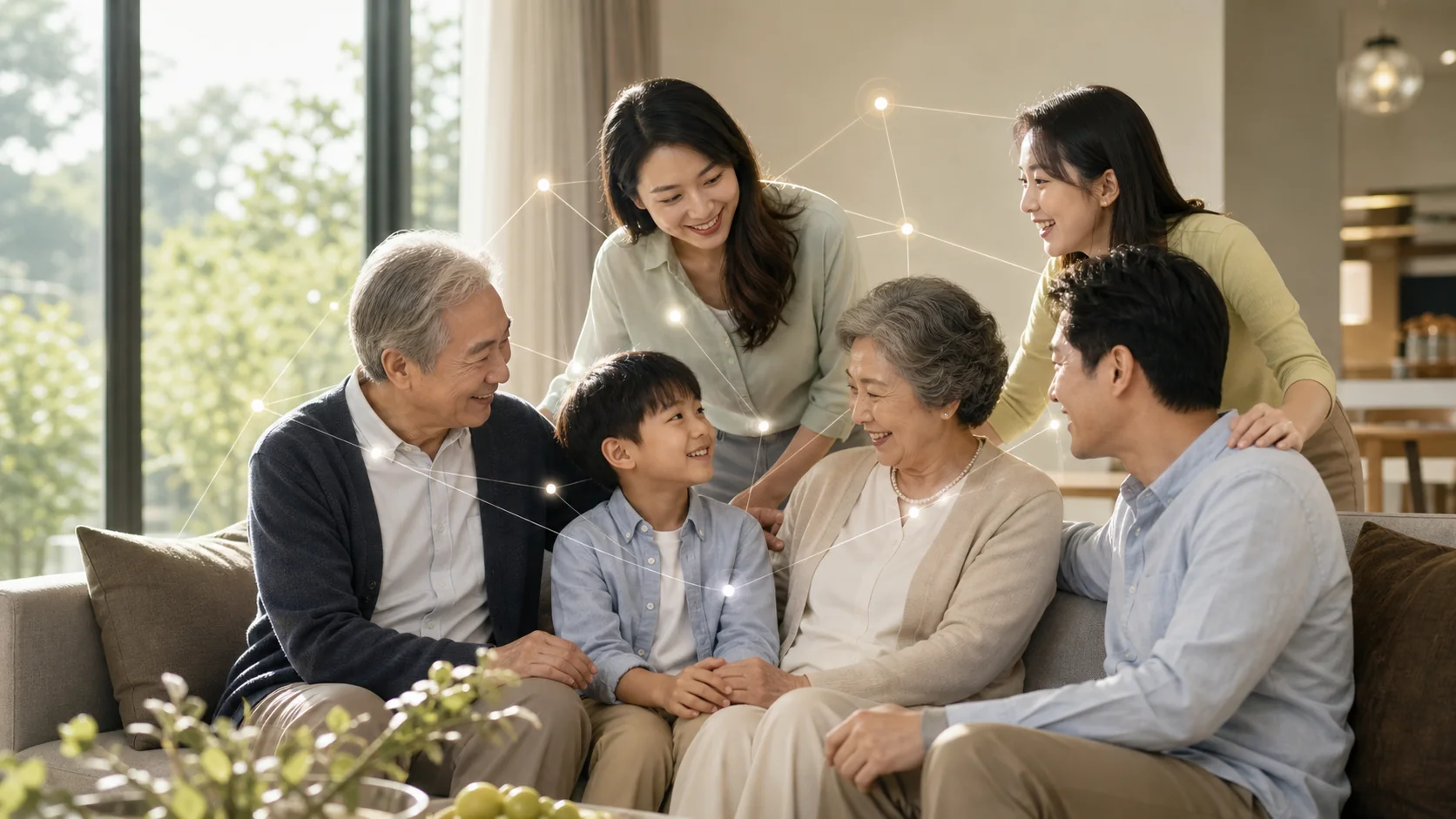
Add parents, spouses, children, siblings, and more relatives around yourself to form a family relationship network that can be collaboratively maintained over time.
Start with yourself and add parents, spouses, children, and more relatives. The system automatically organizes generations and kinship relationships. Invite family members to confirm information together, so scattered names, photos, and family memories gradually become a digital family tree that can be maintained over time.
Add parents, spouses, children, siblings, and more relatives around yourself to form a family relationship network that can be collaboratively maintained over time.
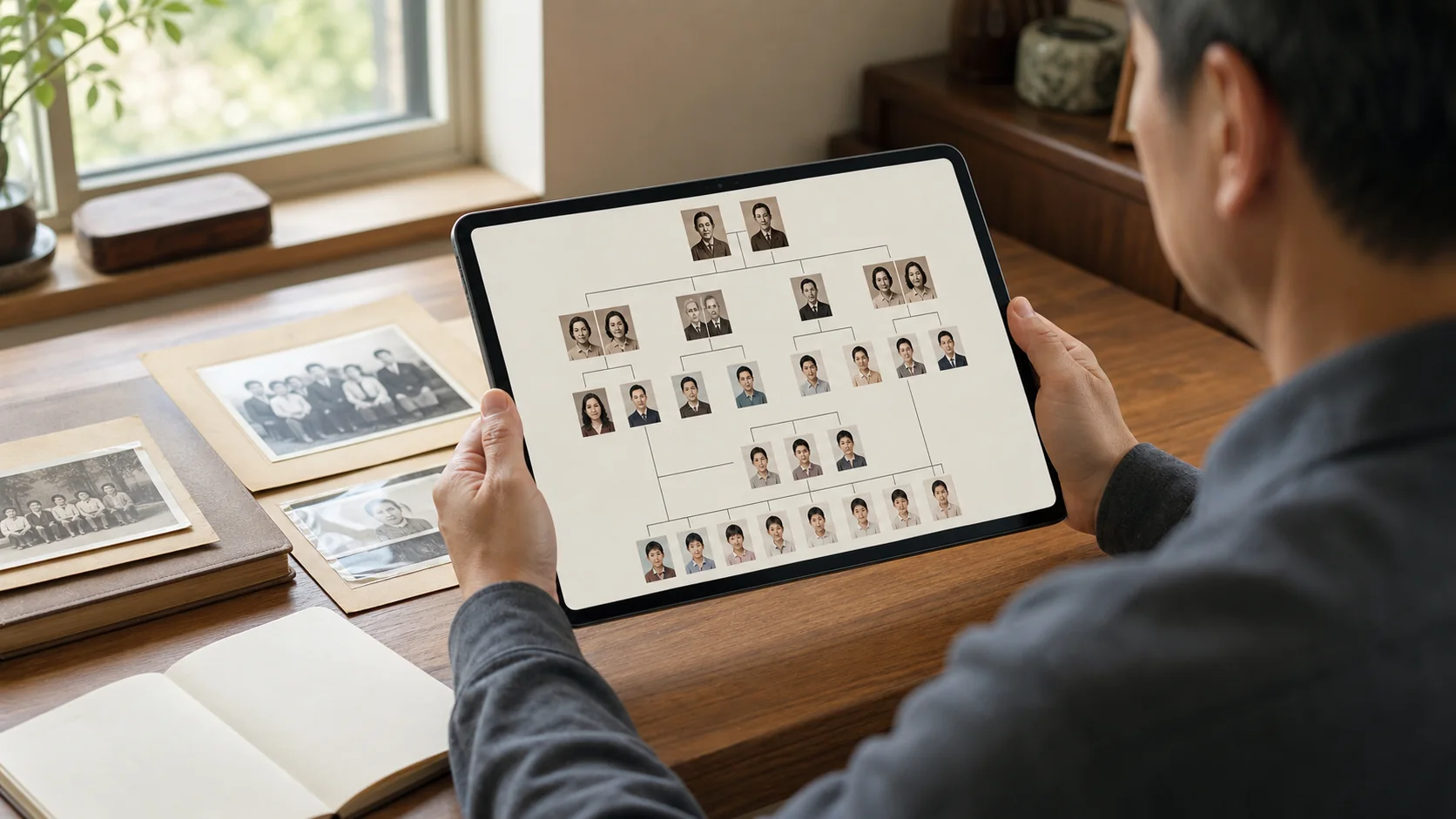
Automatically organized by generation, direct line, and collateral branch position, generating a genealogy tree closer to a formal lineage structure for family members to view together.
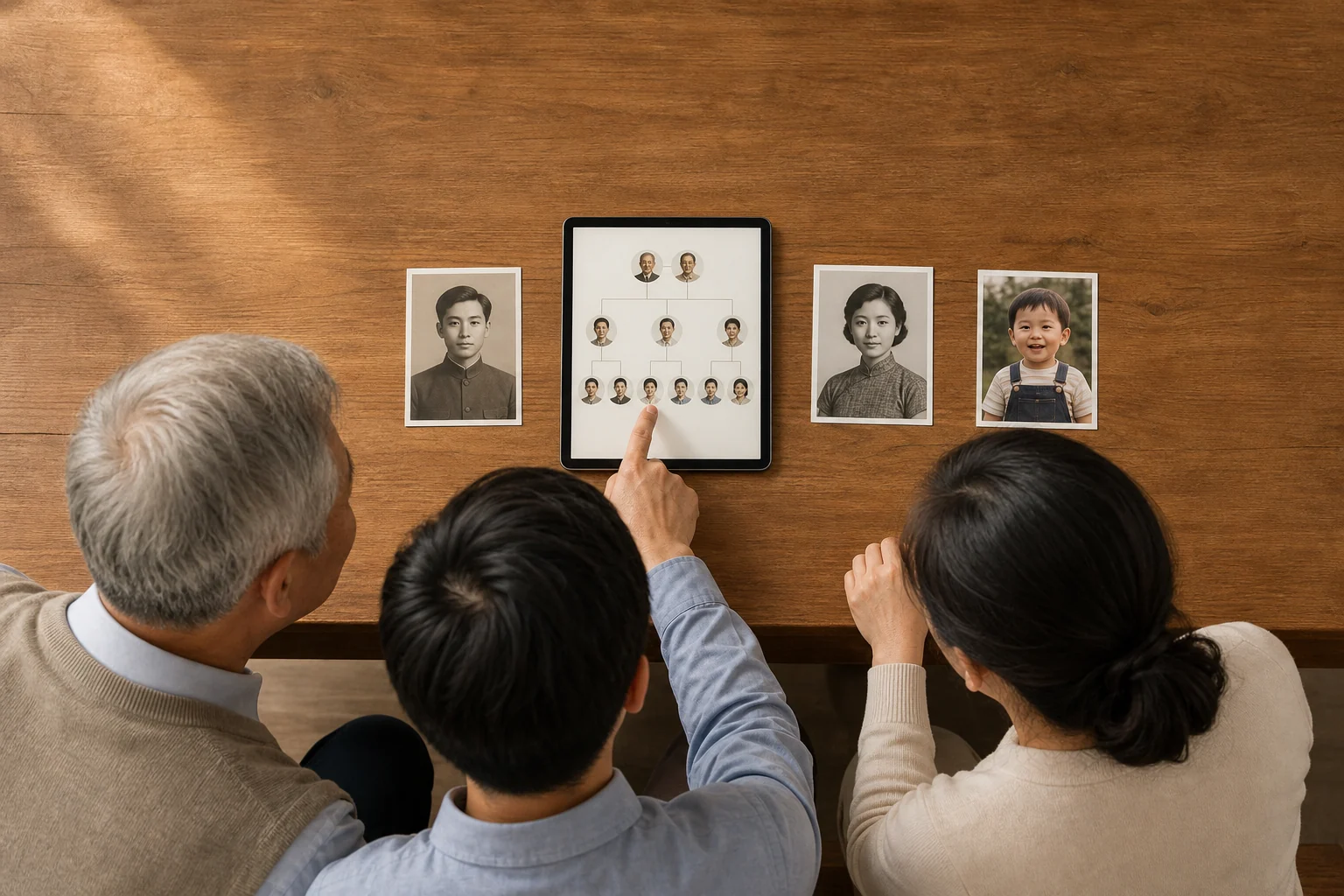
Send a confirmation link to family members so those familiar with the details can add and verify information together, reducing incorrect entries, omissions, and duplicate people.
A family tree is not only an arrangement of names and generations, but also a record of a family’s origins, migrations, marriages, occupations, stories, photos, and shared memories. A digital family tree allows information to be recorded first, then confirmed by relatives, and continuously supplemented and preserved within the family.
Centered on a family or a line of descendants, it records parents, spouses, children, ancestors, siblings, and the continuation of later generations.
Within the scope of people sharing the same surname and ancestry or the same branch, it often includes hall names, ancestral commanderies, generational names, origins, migrations, and family figures.
It places greater emphasis on the clan community, ancestral halls, genealogy prefaces, family rules and teachings, ancestral hall property and rituals, and the order of transmission across generations.
First place information scattered across elders’ memories, WeChat groups, old photos, printed genealogies, and family oral accounts into the same structure, then gradually check and improve it.
Record parents, spouses, children, siblings, ancestors, and collateral relatives, and show the kinship connections between each person.
Generate a lineage structure based on generations, direct lines, collateral branches, spouses, and children, making it easier to view relationships between older and younger generations in the family.
Save each relative’s name, gender, date of birth, location, spouse, children, life history, photos, and notes.
Use invitation links to let relatives confirm their own identities and information, reducing incorrect entries, omissions, and duplicate records.
Keep a verification process for personal relationships and important information, allowing family members to gradually confirm family information from different sources.
A family tree is no longer a one-time document, but a family database that can be continuously supplemented, revised, shared, and passed down.
Create an account and first set up your own profile and basic family information.
Start with parents, spouses, and children, then gradually add ancestors and collateral branches.
Send the link to relatives so they can confirm and add their own information.
Merge duplicate individuals and verify lineage, generational names, place names, and birth and death information.
View the family relationship network, family tree, and detailed genealogical records for each person.
Update promptly after important family events, and regularly review and back up the records.
These are also among the topics many families search for most often when they begin creating a family tree, clan genealogy, or lineage record.
Registration and online digital family tree creation are free. You can start by adding relatives from yourself and view the family tree and family relationship network.
Yes. First enter the relatives and relationships you can confirm, then invite family members to gradually supplement and verify the information.
The creator can send confirmation links to relatives, allowing the person themselves or family members familiar with the situation to confirm identities, relationships, and information.
Family tree information is primarily maintained within the family. Sensitive information such as ID numbers and detailed addresses should not be displayed on public pages. Authorization from the person concerned or the family should also be obtained before entry.
You can start by clearly recording yourself, parents, spouse, children, ancestors, and siblings, then add dates of birth, locations, brief biographies, photos, migration places, and generational names. For information that cannot be confirmed for the time being, the source and confirmation status should be recorded.
Generational names usually come from old genealogies, ancestral hall inscriptions, oral accounts from elders, clan association materials, or local branch records. Even for the same surname, different hall names or different migrating ancestors may have completely different generational names.
A commandery origin is a historically influential regional identifier for a surname or branch, while an ancestral hall name is often used for ancestral halls, genealogies, tombstones, and clan identity. Actual usage should be based on the old genealogy of the branch and local documents.
Modern digital family trees are recommended to fully record real family relationships, and women, spouses, and children can all be saved as family members.
Yes. Many families start with existing family relationships, first recording information within three generations, then gradually completing it through relatives’ oral accounts, old photos, tombstones, household registration clues, and local documents.
It is recommended to make oral records as soon as possible. Start with audio or video recordings, then organize them into short biographies, migration stories, family chronologies, and genealogy notes.
Not necessarily, but full dates of birth help distinguish people with the same name and confirm generational relationships. If uncertain, you can record only the year or mark it as “circa.”
You can record the year of death, burial place, life history, spouse and children, photos, and relatives’ oral accounts. In a digital genealogy, the person can be marked as deceased to help later generations identify them.
They can be distinguished by year of birth, parents, spouse, children, place of residence, birth order, generational name, and notes, to avoid merging people from different branches.
Duplicates may occur, so names, mobile numbers, parent-spouse-child relationships, and birth information should be compared, and duplicates should be merged after they are found.
A person’s own information is best confirmed by that person. Information about deceased relatives can be jointly confirmed by the spouse, children, siblings, or elders familiar with the family situation.
A family tree emphasizes generations and lineage structure, making it suitable for viewing ancestors and descendants. A family relationship network emphasizes all kinship links, making it suitable for viewing relationships such as parents, spouses, children, and siblings.
In a digital genealogy, a spouse is displayed in association with the person and clearly linked to the children they share.
Each marriage, spouse, and corresponding children should be recorded separately according to the actual relationships, to avoid mixing children born to different spouses.
Yes. It is recommended to note facts such as adoption, stepchildren, or foster relationships in the remarks. The formal presentation in the genealogy can be discussed by the family.
Yes. A digital family tree records real kinship relationships, and daughters and their children are part of the family relationship network.
The actual marriage and child relationships should be recorded, with notes explaining the matrilocal marriage, surname change, succession, and other circumstances to avoid misunderstanding by later generations.
For adoption for succession, it is recommended to retain clues for both the biological parents and adoptive parents, and clearly state the time, reason, and basis for the adoption in the notes.
It is not recommended to display ID numbers in a public family tree. Necessary identity information may be stored carefully for internal management, but privacy and authorization should be taken into account.
A mobile number is suitable for login and invitation confirmation, but it cannot fully replace identity verification. Genealogical relationships should still be confirmed together with kinship relationships and personal confirmation.
Family tree information should be jointly managed by the family that entered it or authorized family members, and the platform should provide capabilities for saving, exporting, and privacy protection.
Information involving living relatives is not recommended for public disclosure. Suitable public content includes surname culture, ancestral hall names and commandery origins, genealogy knowledge, and historical materials that do not contain private information.
Archive by person, family event, era, and location, and add names, shooting dates, locations, and story notes next to the photos.
It can serve as an important clue, especially for names, birth order, dates of birth and death, spouses, children, and ancestral hometowns, but it is still recommended to cross-check it against old genealogies and oral accounts.
Old place names should be kept in their original form, with the corresponding current province, city, district, or approximate area added to help later generations understand migration routes.
It is best to record the type of date. If elders only remember the lunar date, it should be marked as lunar to avoid errors caused by later conversion.
The time of birth is not required, but some families value traditional records, so it can be preserved as optional information.
They can be included, but should be kept concise. Occupation, education, and major life experiences can help later generations understand a person’s life and historical context.
A brief biography can include birthplace, family relationships, career experience, personal qualities and deeds, migration changes, major contributions, and memories from relatives, while avoiding vague general praise.
It can record relocation, house building, starting a business, military service, school advancement, weddings and funerals, ancestor worship activities, and other important family events.
They can be included as a genealogy appendix or a family culture page, recording ancestral instructions, family values, family rules, ritual guidelines, and shared agreements among descendants.
A genealogy preface is an introductory section at the beginning of a genealogy, usually explaining the reason for compiling it, the family’s origins, recording principles, scope of materials, and significance of inheritance.
Editorial notes explain the compilation rules of a genealogy, such as generational order, person-entry format, how women are recorded, rules for spouses and children, and methods for citing sources.
A lineage chart uses a tree structure to show the line of succession from ancestors to descendants, and is one of the core structures in a genealogy.
A generational table lists people in order by generation, and may include generation names, birth order, spouses, and children.
A branch lineage refers to a branch system formed by descendants of the same ancestor in different regions or through different descendant lines.
A founding ancestor usually refers to the person who moved a particular branch into a place, began its continuity there, and was later honored by descendants as the source of that branch.
A migration ancestor is an ancestor of key significance in a family’s relocation process, often used to distinguish branches in different regions.
Not necessarily. The original ancestor may refer to the source of a surname or a distant ancestor, while the first-generation ancestor often refers to the first ancestor recorded in the genealogy of a specific branch.
A hall name can be found from old genealogy covers, ancestral hall plaques, tombstones, clan association materials, and local documents, and should not be judged solely by a commonly used hall name for the same surname.
An ancestral commandery is a historical regional identifier often found in surname culture materials. For a specific branch, however, old genealogies and local branch records should still be the basis.
Not necessarily. Many surnames have multiple origins, so people with the same surname may not share the same clan, and people of the same clan may have different surnames because of migration or surname changes.
Yes. Spouses, maternal lines, in-laws, adoption, surname changes, and succession by adoption can all cause different surnames to appear in the same family records.
It is usually easiest to start with yourself, then add parents and grandparents upward, children and descendants downward, and gradually expand to collateral lines.
Yes. First establish the known relationships, then invite relatives to add ancestral hometowns, dates of birth and death, siblings, and migration information.
You can first record the current residence and elders’ oral accounts, then continue checking old photos, tombstones, household registration records, genealogies, place names, and clan connections.
People of the same generation are often ordered by birth order or ranking, while formal genealogies may also refer to generation names and branch rules.
They are generally arranged by birth order. If it cannot be confirmed, they may be temporarily ordered according to known information, with the basis for the order noted.
Common reasons include incomplete entry of kinship relationships, parents or spouses not being linked, duplicate people not being merged, or rules filtering out members outside the branch.
Incorrect relationship lines usually result from inconsistent entry of parents, spouses, children, or siblings, and need to be checked in the person relationships.
You can check each person’s parents, spouse, children, and siblings one by one, then see whether the genealogy tree and relationship network are consistent.
They are suitable for families that value a sense of ceremony, want to preserve a traditional genealogical style, and also want to record personal information in a modern way.
If a genealogy is only a thick book, younger people may not read it; if they can view relationships, photos, and stories on their phones, it is easier to understand and pass on.
A mini program is suitable for relatives to view and confirm information, share profiles, add photos, and enter details on site during family gatherings.
A website is suitable for centralized editing, batch organization, viewing large relationship networks, proofreading information, and management.
A genealogy records relationships and lineages, while a memoir records people’s experiences and stories. Combining the two brings family memory closer to completeness.
Yes. Visual and audio materials can be part of individual profiles or family chronicles, recording voices, appearances, and scenes of daily life.
Start by asking about family members, ancestral hometowns, migrations, marriages, occupations, and important events, then use old photos to confirm people and stories one by one.
You can record an approximate period, such as “around the 1960s,” and later verify it through documents, gravestones, photos, and relatives’ memories.
Do not delete conflicting information directly. Keep the different accounts and note their sources, then update them after more evidence is confirmed.
It is best handled by someone who knows the family well, communicates effectively, and is willing to maintain the information over the long term. Multiple people can also divide the work and collaborate.
They can be categorized by branch, region, contact person, lineage, generation names, and activity records, then gradually imported into the digital genealogy.
Start by confirming the ancestral hometown, surname spelling in pinyin, time of migration, elders’ names, genealogy photos, and immigration routes, then look for clues from local branches.
You can record the place of origin, destination, time, occupation, family contacts, distribution of descendants, and records of contact with the hometown.
You can record the original hometown, migration into Northeast China, reasons for migration, place of settlement, distribution of descendants, and connections with the original branch.
You can look for clues in old local genealogies in Sichuan, oral accounts of ancestral hometowns, generation names, ancestral halls, place names, and materials from clans with the same surname.
Historical famous figures can be included, but surname-culture figures should be distinguished from people in the family’s own branch to avoid mistaking a famous person with the same surname for an ancestor of that branch.
Of course. The meaning of a genealogy is not only to record famous people, but to ensure that every ordinary person’s life is remembered by their family.
Information about minors should be displayed with caution. Public pages are not recommended to show detailed birthdays, schools, addresses, or contact information.
Sensitive information such as living relatives’ contact details, full addresses, and ID numbers should not be made public, and sharing should also be authorized by the person or family.
Yes. A digital genealogy should mainly be viewed within the family, with access controlled through invitations or login permissions.
It is recommended to update it every year or after important family events, such as births, marriages, moves, deaths, further education, and starting a business.
It should be backed up regularly, and important materials are best stored both in the cloud and on local devices.
It is recommended to name them by year, person, and event, such as “1988-Jian XX-Chengdu group photo,” to make future searches easier.
You can first take photos to preserve it, then ask someone familiar with traditional Chinese characters, variant characters, genealogy formats, and local place names to help interpret it.
The original writing from the genealogy should be preserved, while simplified or commonly used forms should be added to the digital records to make searching and reading easier.
Generation characters usually appear in the names of people of the same generation, and may also be listed separately in generation poems, prefaces, or explanatory notes.
Approximate burial locations and grave-sweeping information can be recorded, but precise locations should not be made public, especially when privacy and safety are involved.
You can record the ancestral hall’s name, address, plaques, couplets, construction date, sacrificial activities, photos, and related inscriptions.
It is recommended to keep photos of the original text, then organize the transcribed text, translation, relationships among people, time and place, and source notes.
The original era name can be preserved while adding the Gregorian year; the basis for conversion should be saved together with the original text.
A migration route map is very valuable and can show the ancestral hometown, place of departure, place of settlement, and distribution of descendants.
The surname culture page provides references on origins, hall names, commandery associations, and migrations, while the genealogy page records this family’s real information. The two complement each other.
We recommend noting whether information comes from old genealogies, oral accounts from elders, gravestones, photos, documents, local gazetteers, or clan materials, so future generations can verify it.
Yes. When there are many people, it can be divided into volumes by branch, region, generation, or family division for easier reading and management.
A family division usually refers to a genealogical sub-branch formed by different sons or branches of the same ancestor. It is a common classification method in traditional clan genealogies.
They are often used interchangeably in daily usage, but different genealogies may count them differently. When creating a genealogy, the rules should be unified and the basis should be noted.
It can be named using the surname, region, hall name, and branch, such as “Genealogy of the X Family,” “Genealogy of the X Family in X Place,” or “Clan Genealogy of the X Family of X Hall.”
Long-term preservation depends on data backups, open formats, account management, and ongoing family maintenance. Important materials should be backed up in multiple places.
No. Recording the relatives and stories that can be confirmed now is already a way to preserve clues for future generations.
Continue browsing genealogy knowledge, information templates, surname culture, and family memory content.
A family tree connects a family's past with its future.
You don't need to enter all the information at once. Start with yourself and the relatives you know well, recording and verifying as you go.
Genealogy Overview
Displayed strictly by generation, direct-line, and collateral-line positions, suitable for viewing the formal genealogical structure.
Genealogy Compilation Project
Inclusion Scope
Person Details in Project
Branches and Generations
Book Table of Contents
Pre-publication Verification
Templates and Publishing
Old Genealogy Recognition
PDF, JPG, PNG, and TIFF are supported. Please take photos as straight and clear as possible. You can select multiple genealogy pages at once.
Organizing genealogy pages. Please do not close this page.
AI recognition may contain errors. Please compare with the original genealogy record and confirm, edit, or exclude each relationship.
Please select “Self” from the recognition results. The system will connect relatives starting from Self and import them into the family tree all at once.
Family Relationships
Shows the complete linked relationships between you and all recorded relatives, with horizontal and vertical scrolling available.
Select a member and copy their dedicated confirmation link.
Set the genealogy name, surname, and ancestral hall name/region.
My Family Profile
Starting with one family member, slowly record your family's story.
Relationship Claim
Invitation rewards will only be counted after the relationship is confirmed; if the relationship does not match, please reject it directly.
ZongMai Individual Membership
Invitation rewards are based on family members completing registration, claiming their profiles, and confirming relationships.View Member Benefits & Event Rules
You don't have to complete your profile all at once.
Website and Mini Program Sync
Recordings, transcripts, photos, and memoirs use the same account profile. You can continue collecting materials on the website or keep telling your story in the ZongMai Mini Program.
Start by entering your name. Add other information as applicable; leave anything you're unsure about blank. After making changes, click “Save Profile.”
Oral Memoir Editorial Desk
Each round of storytelling automatically saves the original audio and transcript. AI asks follow-up questions based on what has been shared, personal profiles, and historical clues.
Start by entering the protagonist’s basic information. The system will begin guiding the interview through childhood, family, education, work, and experiences of the times.
Personal Oral History
Click to start narrating. Maximum length per session: 54 minutes.
After completing one round of storytelling, you can continue with follow-up questions based on the transcript, personal profile, and historical context.
After the recording is completed, the original audio and text will be saved here.
Batch transcripts remain unchanged. Edited versions are saved separately as manually proofread versions, and the original source material will not be overwritten.
Names, times, places, and events extracted by AI need to be confirmed by the person involved; conflicting materials will not be written directly as confirmed facts.
First create a chapter outline, then organize the storytelling, confirmed facts, and old photos into the main text.
Points Account
Used across the ZongMai platform for services that support points-based settlement.
Bonus points are used first for spending; if a task is not completed, frozen points will be returned according to their original type.
100 points = 1 yuan. No extra bonus points are included with top-ups in this phase.
Payment results and refund status are subject to WeChat Pay notifications.
This password is shared for mobile number login on the website and mini program.