Clues to Migration and Analysis of Branches in the Pan Family Genealogy
A relatively short Pan family manuscript records clues concerning Pan Chuba and his descendants, including Pan Zili and Pan Ziyi, and points to the distribution of clan members in Kaiping, Guangdong, Malaysia, Hong Kong, and other places. Tracing roots through such materials requires layer-by-layer verification using genealogical records, family memories, and local documents.
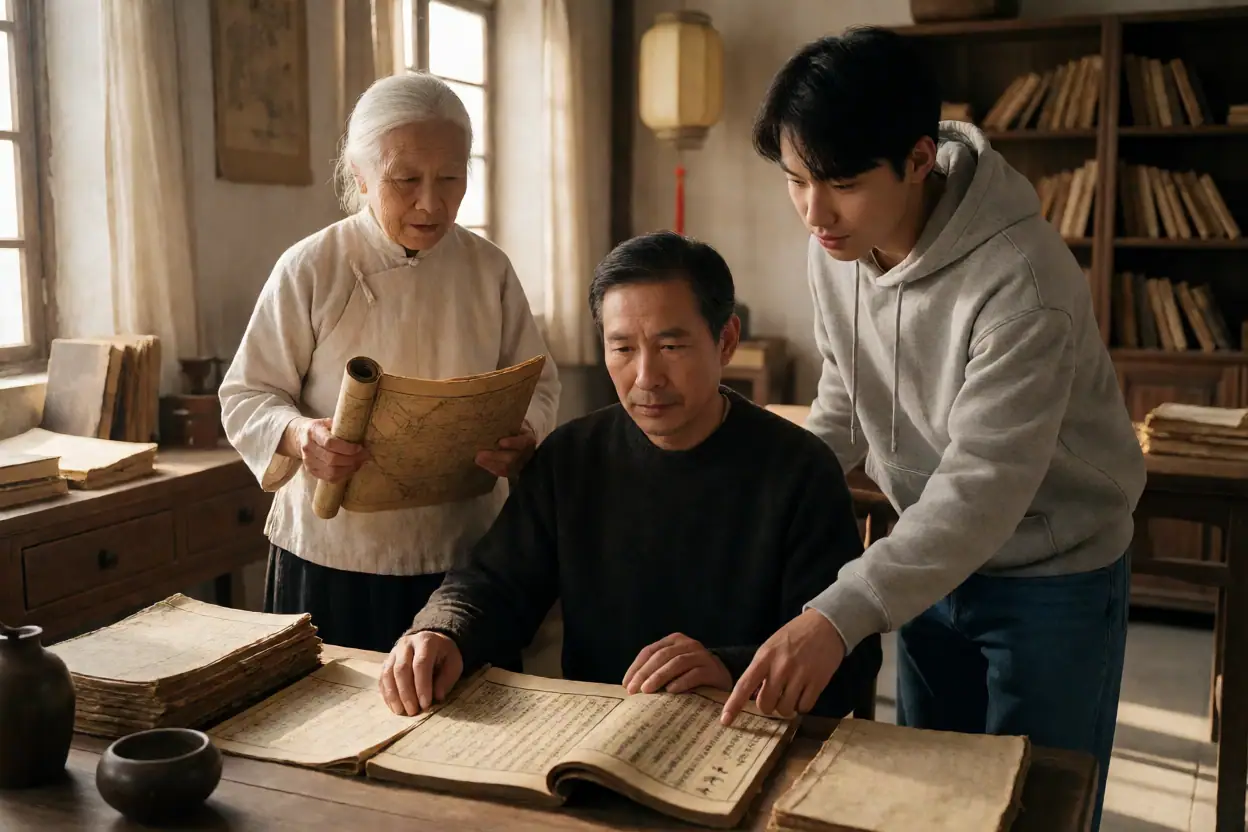
Existing materials indicate that a manuscript titled “Pan Family” is approximately thirteen leaves long and includes portraits of figures, although its date of compilation has not yet been established. Important clues found in the genealogy include Pan Chuba, followed by references to Pan Zili and Pan Ziyi. The records also mention that members of the clan were dispersed across Kaiping in Guangdong, Malaysia, Hong Kong, and other places. As this material is a manuscript of limited length, it is currently more appropriate to regard it as a set of family clues requiring further investigation, rather than using it to directly reconstruct a complete lineage.
Whether Pan Chuba was the founding migrant ancestor of a particular branch still needs to be determined in conjunction with the original genealogy’s records of generational succession, generation names, places of residence, marriages, and burials. Although the records refer to the relationship between Pan Zili, Pan Ziyi, and Pan Chuba using terms such as “first ancestor” and “second-generation ancestor,” the precise generational connections, branch divisions, and destinations of their descendants should still be verified against the original genealogy pages and other documents concerning the same clan. It is especially important to note that the Pan surname is widely distributed, and people with the same surname may come from different lineages. Shared surnames, lineage hall names, or places of residence alone cannot establish that they belonged to the same clan.
There has long been movement of people between Kaiping in Guangdong, Hong Kong and Macao, and Southeast Asia. If family memories preserve information about the time of departure overseas, the village of origin, the location of the ancestral home, the embarkation point, overseas remittance letters, gravestones, or ancestral halls, these materials may help narrow the scope of the investigation. Genealogies, family letters, lists of clan members, and family memoirs preserved by descendants in Malaysia and Hong Kong can also be cross-referenced with village gazetteers, county gazetteers, ancestral-hall inscriptions, and burial records from Guangdong. Judgments about migration routes should distinguish between the ancestral place of origin, former place of residence, point of departure, and place of settlement or registration, so as to avoid mistaking a later place of residence for the original place of origin.
When researching the Pan family’s origins, begin by organizing the names, birth order, generation names, places of birth, and dates of relocation that can be confirmed within the family, then compare them item by item with lineage nodes in online genealogies. If identical names are found, further verification of spouses, siblings, children, and places of residence is still required. Local gazetteer databases can help locate records concerning villages, respected local figures, overseas-Chinese communities, and ancestral halls in Kaiping. Surname materials can be used to understand the background of different Pan lineages, but cannot replace genealogical evidence for a specific branch. Terms such as “first ancestor,” lineage hall names, and legends concerning ancient surname origins should be separately labeled as terms used within the genealogy, traditional accounts, or suppositions still awaiting verification. Only when genealogical records, local documents, family memories, and physical evidence correspond with one another can conclusions about the relevant lineage and migration be considered more reliable.