The Cultural Formation of Guan Yu Worship Through the Confluence of the Three Teachings
Guan Yu belief was not the product of a single religious tradition; rather, it gradually took shape through the long-term interaction of local folk customs, the spread of Buddhism, Daoist concepts, and Confucian ethics. When examining surname materials, genealogies, and local gazetteers together, it is also necessary to distinguish cultural identity from actual lineage.

Guan Yu worship had a distinctly composite character in traditional Chinese society. Confucianism emphasized loyalty, righteousness, and personal honor; as Buddhism spread locally, it continually absorbed elements of regional belief; and Daoism excelled at interpreting popular experience through protection, exorcism, and divine genealogies. Although the three traditions each had their own systems, they produced overlapping interpretations around the figure of Guan Yu, who was thus regarded both as a loyal and valiant minister and as a protector of the Dharma, a divine general, or a local guardian deity.
The formation of this belief was not an overnight process. The areas where Guan Yu lived and died already had strong traditions of local worship; after the Sui and Tang dynasties, the establishment of Buddhist monasteries and their teaching activities provided new narrative frameworks for related legends. Stories of Guan Yu manifesting himself and assisting in the construction of monasteries appear in Tang-dynasty writings and temple inscriptions, but such materials primarily reflect the forms of religious expression and cultural transmission of the time and cannot simply be equated with direct proof of historical facts. As stories about Guan Yu spread across different regions, his image was gradually incorporated into the shared context of Buddhist guardian deities, Daoist gods, and Confucian ethics.
Official titles and honors bestowed throughout successive dynasties, the construction of local temples, and popular worship further strengthened Guan Yu's public cultural status. Couplets, inscriptions, and rituals at Guan Yu temples often brought together meanings such as loyalty, righteousness, protection of the state, and the safeguarding of the people. The resulting worship of Guan Yu thus encompassed not only religious elements but also the state ritual system, local social order, and popular moral imagination. Traditions surrounding Guan Yu temples differed from region to region, and related titles, divine identities, and rituals also changed with time and place. They should therefore be regarded as a continually evolving cultural phenomenon rather than a fixed and unchanging system of belief.
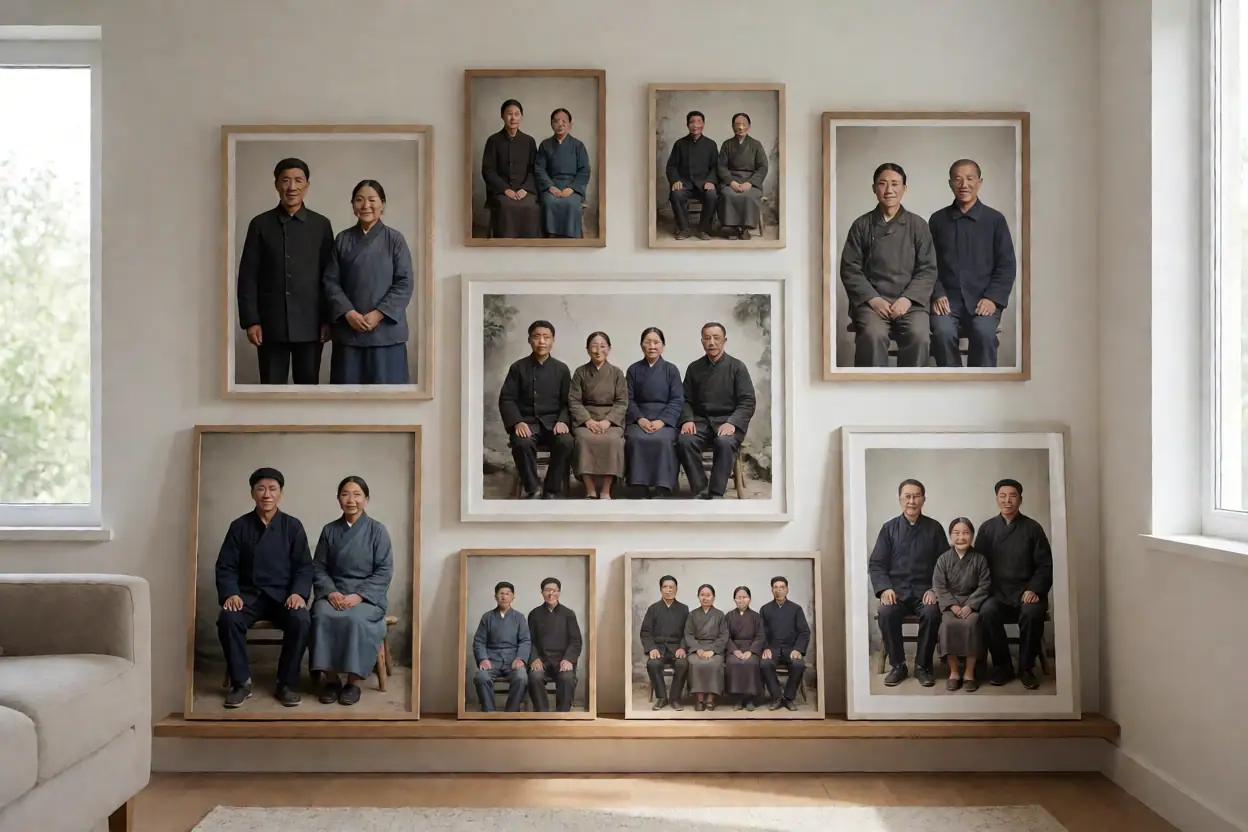
From the perspective of surname studies and family memory, Guan Yu belief can also serve as a clue to the study of local society, but it cannot be used to infer a blood relationship between any particular surname and Guan Yu. Taking the Chong surname as an example, existing surname materials describe it as having multiple origins and record hall names such as Kuaiji Hall, as well as ancestral-origin places including Kuaiji, Wujun, and Henan. These details can serve as a starting point for tracing family distribution and documentary leads, but they are insufficient on their own to prove that Chong families in different regions belong to the same branch. Sharing a surname does not mean sharing the same lineage, and hall names or ancestral-origin places do not necessarily correspond to a single continuous genealogy.
If a memoir of a Chong family in a particular locality, an online genealogy, or a local gazetteer contains references to Guan Yu temples, worship, or stories of protection and blessing, the more prudent approach is first to record the specific place, people, date, and version of the source, and then compare them with migration records in genealogies, inscriptions at ancestral halls, and local gazetteers. Surname databases can help organize information on the distribution and hall names of Chong families; online genealogies and family memoirs can help locate modern memories; and local gazetteers can supplement information on the history of temples and the local social context. Only when multiple types of material corroborate one another is it appropriate to further discuss the value of such accounts for family history. This approach makes it possible both to understand the cultural influence of Guan Yu worship under the confluence of the Three Teachings and to avoid misrepresenting a shared folk belief as an unverified clan origin.
Learn More and Verify
- The Five Luminaries of the Chen Family: The Cultural Trajectory of Four Generations of the Chen Family of Yining
- Situ Surname Popular Library: A Public Cultural Space in the Cultural and Educational Memory of an Overseas Chinese Hometown
- The Cultural Continuity and Local Memory of the Qingyang Mao Clan
- The Family-Cultural Memory of Wenxi Peibai Village and the Hedong Pei Clan
Genealogy Knowledge and Methods for Compiling Genealogies · Finding Genealogies and Local Gazetteers · Organize family-root-seeking leads